Splitting the Monolith: The Operational Costs That Don't Show Up in the Architecture Diagram
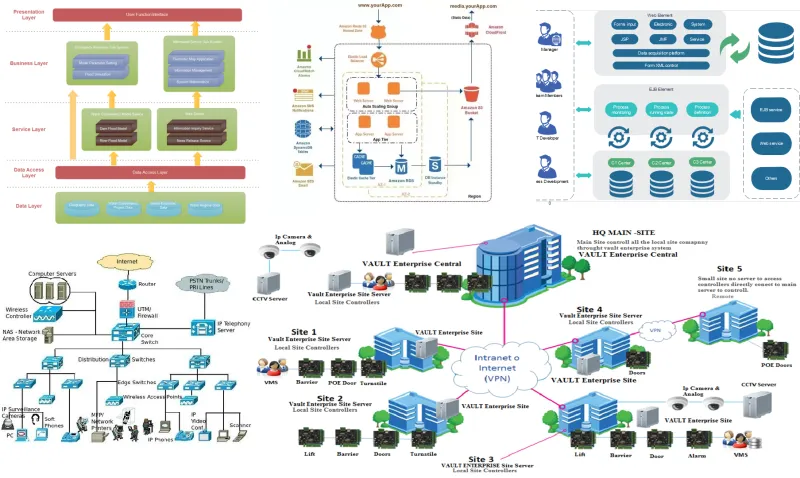
Photo: software architecture complexity server infrastructure network diagram, via understandingcontext.com
Few decisions in enterprise software carry as much symbolic weight as the choice to migrate from a monolithic application to a microservices architecture. It signals modernity. It implies scalability. It suggests that an organization is serious about its digital future. For many technology leaders, the appeal is almost self-evident — smaller, independent services that can be deployed, updated, and scaled in isolation seem like a clear improvement over a single, tightly coupled codebase.
But the architecture diagram rarely tells the full story. What it shows is a clean grid of labeled boxes connected by arrows. What it omits is the operational reality that follows: the sprawling infrastructure, the debugging sessions that span a dozen services, the deployment pipelines that require constant attention, and the team coordination overhead that quietly consumes engineering capacity. For organizations that proceed without a clear-eyed assessment of these costs, microservices can become less of a solution and more of a new category of problem.
The Complexity Transfer Problem
One of the most important things to understand about microservices is that they do not eliminate complexity — they relocate it. A monolithic application concentrates complexity within a single codebase. That concentration can be uncomfortable, particularly as the codebase grows, but it also means that the system's behavior is relatively observable. A developer can trace a transaction from end to end without crossing service boundaries, authentication layers, or network calls.
When that same application is decomposed into a network of independent services, the internal complexity of the monolith is replaced by distributed system complexity. Services must communicate reliably across network boundaries that are, by definition, less dependable than in-process function calls. Failures become partial rather than total — a service may be slow, intermittently unavailable, or returning stale data, and diagnosing the root cause requires correlating logs and traces across multiple systems simultaneously.
For organizations with mature site reliability engineering practices, robust observability tooling, and dedicated platform engineering teams, this complexity is manageable. For mid-market companies operating with lean engineering departments, it frequently is not.
When the Debugging Session Becomes an Expedition
Consider the experience of a regional logistics software provider that undertook a microservices migration after years of growth on a monolithic platform. The stated goal was to allow independent teams to ship features faster. Within eighteen months, the company had decomposed its core application into over forty discrete services. Deployment velocity, at first, improved noticeably.
Then the production incidents began. A latency spike in the order processing pipeline turned out to involve five separate services, two message queues, and a third-party API integration — none of which surfaced the problem directly in their logs. Engineers spent the better part of a business day reconstructing the sequence of events across distributed traces. What would have been a two-hour debugging session in the monolith became a full-day investigation requiring coordination across three separate teams.
This is not an isolated anecdote. It reflects a structural challenge that distributed systems engineers have understood for decades: when a transaction crosses multiple service boundaries, the diagnostic surface area expands dramatically. Without investment in centralized logging, distributed tracing infrastructure, and clear service ownership, debugging becomes an expedition rather than a routine task.
The Team Structure Assumption That Often Goes Unexamined
Microservices architecture is frequently described as enabling organizational scalability — the idea that independent services allow independent teams to work without stepping on each other. This principle is sound, but it carries an implicit assumption: that the organization actually has enough engineers to staff those independent teams meaningfully.
The Conway's Law dynamic is well documented in software engineering literature. Systems tend to mirror the communication structures of the organizations that build them. For large technology companies with hundreds of engineers organized into product-aligned squads, microservices can genuinely reduce coordination friction. For a company with twelve engineers supporting a business-critical platform, the same architecture may simply mean that each engineer is now responsible for maintaining multiple services, managing inter-service contracts, and staying current on a much broader infrastructure footprint.
The result is often the opposite of the intended outcome. Rather than enabling faster, more autonomous delivery, the architecture creates a coordination tax that slows everything down. Service boundaries require explicit versioning and contract management. A change in one service's API can cascade into required updates across several consumers. What should have been a contained feature addition becomes a multi-service coordination effort.
Where Microservices Actually Deliver
None of this is an argument against microservices as an architectural pattern. There are genuine, well-documented scenarios in which service decomposition delivers significant value. High-traffic consumer platforms with discrete functional domains — payments, notifications, user profiles, content delivery — benefit from the ability to scale individual components independently without provisioning resources for the entire application. Teams working on genuinely distinct product surfaces, with clear ownership and stable service contracts, can move faster when they are insulated from changes in other parts of the system.
The critical distinction is between decomposition that follows natural seams in the business domain and decomposition that is pursued for its own sake. Organizations that have invested in domain-driven design, identified clear bounded contexts, and built the observability and deployment infrastructure to support distributed services are well-positioned to capture the benefits. Organizations that decompose primarily because microservices are perceived as the modern standard often find themselves managing infrastructure complexity without a corresponding improvement in delivery capability.
The Honest Assessment Before the Migration Begins
For technology leaders evaluating a microservices migration, the most productive questions are not architectural — they are operational and organizational. Does the engineering team have the capacity to maintain a distributed system effectively? Is there existing investment in observability tooling, or would that infrastructure need to be built from scratch? Are the service boundaries being proposed aligned with genuine domain boundaries, or are they arbitrary divisions of an existing codebase?
Perhaps most importantly: what specific problem is the migration intended to solve? If the answer is deployment velocity, there may be less disruptive paths worth evaluating first — modularizing the monolith, improving the CI/CD pipeline, or identifying the specific bottlenecks that are constraining delivery speed. If the answer is independent scalability for specific high-load components, a targeted extraction of those components may achieve the goal without the full overhead of a wholesale decomposition.
At OleanSoft, we have observed that the organizations most satisfied with their architecture decisions are those that treated the question of microservices versus monolith as a pragmatic engineering choice rather than a statement of technical ambition. The architecture that serves the business is the one that the team can actually operate, debug, and evolve over time — regardless of what it looks like on the diagram.
Breaking apart a monolith is not inherently a step forward. Done without the operational foundation to support it, it is simply a different kind of technical debt — one that tends to be considerably harder to see coming.